
Spanish Levels A1–C2: What You Can Actually Do at Each Stage
Spanish levels can be hard to understand, but here’s what you need to know: the CEFR describes six main levels, from A1 to C2. They fall within three major groups: Basic User (A1 and A2), Independent User (B1 and B2), and Proficient User (C1 and C2). This guide looks at what those levels mean in real life, and we tackle the question, “What makes someone fluent in Spanish?”
Want Spanish levels explained without getting lost in the labels? Jump to the A1–C2 chart, six levels, conversational Spanish, B1 vs B2, or FAQ.
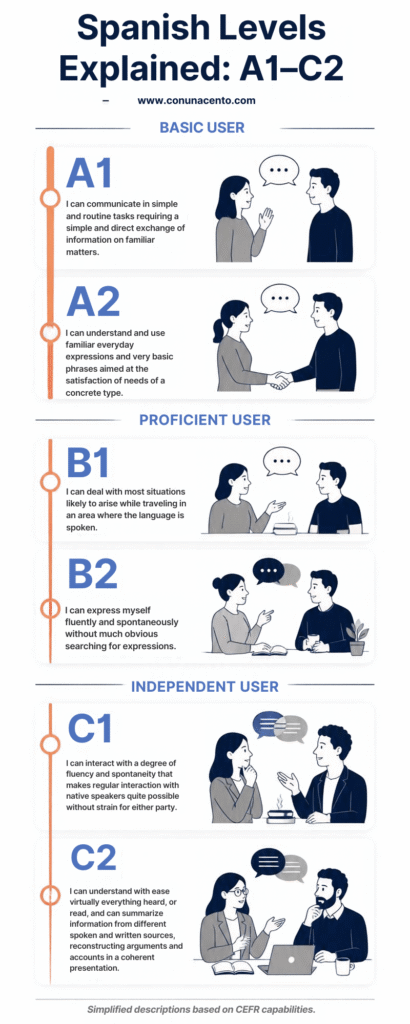
Spanish Levels at a Glance: A1 to C2 Chart
Here are the six levels of Spanish proficiency at a glance. The beginner-to-mastery labels are common teaching labels; the official CEFR groups are Basic User, Independent User, and Proficient User.
| Level | Common label | What you can do |
|---|---|---|
| A1 | Beginner | Introduce yourself and ask basic personal questions, with help from the other person. |
| A2 | Elementary | Exchange information in routine situations, such as shopping or talking about your day. |
| B1 | Intermediate | Handle most travel situations, describe experiences, and briefly explain your opinions. |
| B2 | Upper-intermediate | Sustain conversations, discuss more complex topics, and explain the pros and cons of an idea. |
| C1 | Advanced | Communicate flexibly in social, academic, and professional settings, including implied meaning. |
| C2 | Mastery | Express subtle distinctions precisely and bring together information from demanding sources. |
These are plain-English summaries of the Council of Europe’s CEFR descriptions. A single sentence cannot prove someone’s level: an A1 learner and a C2 speaker can both say “Hola, buenos días” (“Hello, good morning”). What changes is the range of situations they can handle and how independently they can handle them.
What the CEFR Is (and What It Doesn’t Tell You About Spanish Levels)
Okay, you’ve seen this term a few times in this article now. But what exactly is the CEFR? The Common European Framework of Reference for Languages is a framework that describes what you can do in a language. For Spanish specifically, it gives us a shared way to describe Spanish proficiency levels.
Some people need evidence of their level for jobs or to get into specific schools. Others use it as a frame of reference to understand where they are and what they can expect at the next level. The CEFR is not a test itself; exams and courses can use it to assess your abilities.
Of course, the idea behind it is great. However, it doesn’t actually tell you how native you sound. Personally, I’ve known people whose everyday Spanish seemed stronger than their exam result suggested. At the end of the day, an exam measures your performance on specific tasks. And like everything else in life, some days are good days and other days are bad days.
Plus, the CEFR doesn’t give you one universal cutoff for being fluent, or a fixed number of study hours needed to reach the different levels of Spanish. It does describe fluency as part of language performance, but that isn’t the same as handing out a simple fluent/not-fluent label. And it goes without saying, but not everyone fits into one perfect level across every skill.
The 6 Spanish Proficiency Levels Explained
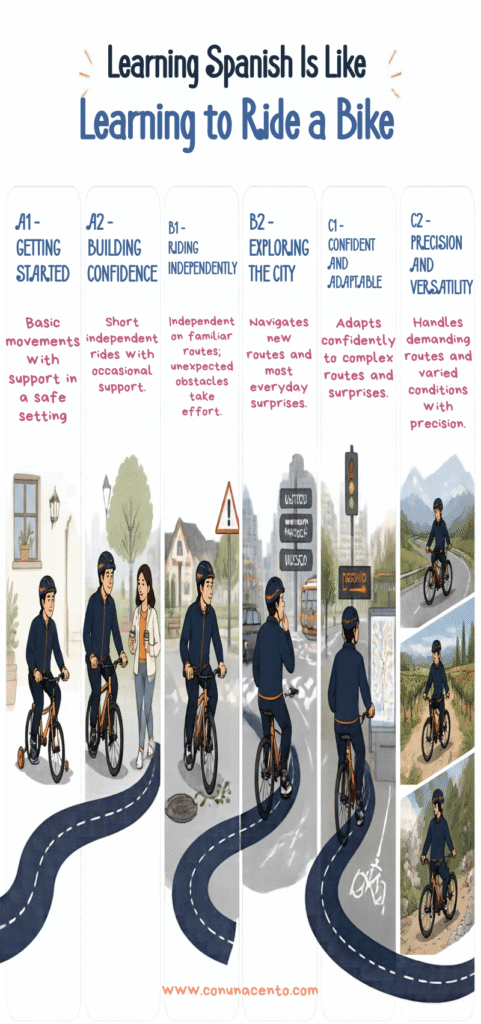
To explore the different Spanish proficiency levels, we’re going to use riding a bike as an example. Think about the routes you can handle, how much help you need, and how well you adapt when something unexpected happens. It’s a metaphor, not an official CEFR comparison. Note: there is a graphic at the end of this section if you’re in a rush!
To help you better understand the levels, we’re going to use a common experience we’re all familiar with: riding a bike. At each level, we will discuss what the equivalent is when learning to ride a bike.
A1 Spanish (Beginner)
At this level, you are on training wheels and learning the bare basics. For example, you’re learning how to balance, street, and brake. Typically, this takes place in your driveway or somewhere very safe.
What’s possible in Spanish
- Everyday use: Introductions, sharing personal details, or asking for something basic.
- Listening: Recognizing familiar words and basic phrases when someone speaks slowly and clearly.
- Reading: Signs, names, prices, or very short familiar sentences.
- Speaking: Asking and answering basic personal questions, with repetition or rephrasing when needed.
- Writing: Writing a very short, simple message.
A2 Spanish (Elementary)
Here, you’ve starting pedaling on your own. Taking familiar routes are possible, but unfamiliar ones require you to ride with a buddy.
What you can do in Spanish
- Everyday use: Routine errands involving a simple information exchange, such as buying a ticket or arranging a meeting.
- Listening: Catching the essentials of short, clear messages on familiar subjects.
- Reading: Short messages and finding predictable details in menus or timetables.
- Speaking: Brief exchanges about routines, family, work, or an immediate need, but there is difficulty maintaining an actual conversation.
- Writing: A short note, simple personal message, or basic description.
B1 Spanish (Intermediate)
Following, you gain a sense of independence. Familiar roads by yourself are no problem, but you might still do occasional awkward braking, and have less confidence with complicated traffic.
What’s possible in Spanish
- Everyday use: Handling a small travel problem or familiar conversation.
- Listening: Following the main points of most familiar conversations are easier.
- Reading: Straightforward texts on familiar subjects, such as personal messages or everyday information.
- Speaking: Starting to tell connected stories and brief reasons for opinions or plans, with pauses and workarounds.
- Writing: Personal messages, description of an experience, or simple explanations.
B2 Spanish (Upper-Intermediate)
At this point, you’re riding through towns and small cities; you’re able to handle busier routes and react more confidently to changes.
Where your Spanish is at now
- Everyday use: Join discussions with competing opinions or a problem requiring negotiation, rather than just ordering a coffee.
- Listening: Easily following extended speech and complex arguments when the topic is reasonably familiar.
- Reading: Capable of reading articles or reports that present viewpoints, rather than only basic factual information.
- Speaking: Sustained interaction, explanations, and pros and cons without constant support.
- Writing: Clear, detailed emails, reports, or arguments with supporting reasons.
C1 Spanish (Advanced)
Finally, you’re riding through most cities with easy and complicated routes no longer scare you. Despite this, unfamiliar conditions may still require your attention.
Here’s what you can do in Spanish
- Everyday use: Demanding social, academic, or professional situation, with shifts in tone or an implied message.
- Listening: Understanding extended speech when the organization or connections are not stated explicitly.
- Reading: Long, demanding texts and differences in style or implied meaning.
- Speaking: Flexible, spontaneous expression and adapting language to the setting.
- Writing: Well-structured text on a complex subject, with suitable tone and clear emphasis.
C2 Spanish (Mastery)
Lastly, you can tackle entirely unfamiliar cities or even taking on mountain routes. Here, the important thing is that you adapt with amazing control and precision.
Qué puedes hacer en español
- Everyday use: Handle a demanding task involving synthesis, ambiguity, or a subtle distinction in meaning.
- Listening: Handling a wide range of demanding speech; acknowledge that an unfamiliar accent can still take adjustment.
- Reading: Complex texts with subtle stylistic or logical distinctions.
- Speaking: Precise reformulation and shades of meaning, rather than perfect pronunciation or an absence of all errors.
- Writing: Complex argument or synthesis shaped for a particular audience and purpose.
For writing these examples, use the Council of Europe’s self-assessment grid and Instituto Cervantes’ Spanish-language CEFR summaries as reference points. Keep your examples original and describe abilities someone can demonstrate consistently, rather than assigning a level to one sentence.
What Level Is Conversational Spanish?
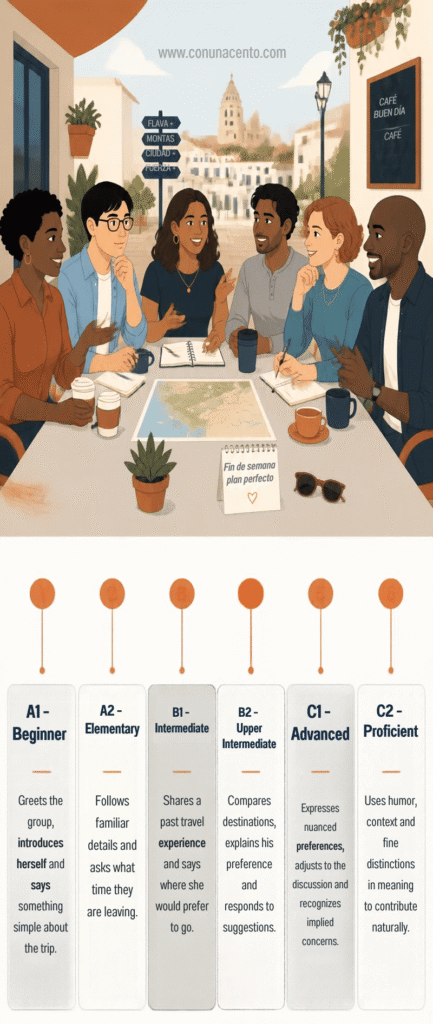
There is no official CEFR cutoff for conversational Spanish. A2 can be enough for short, routine exchanges. B1 is a useful reference point for conversations about familiar things, while B2 describes more sustained, spontaneous interaction.
Alright, so here is where the labels don’t translate neatly into real life. For some, being conversational means being able to handle small talk. For others, it might mean getting through a basic errand without switching into English. The same errand can start with a simple request and turn into a much harder conversation if something goes wrong or the person you’re speaking with is chatty.
Laughing at jokes because you actually understand them, or noticing that people no longer slow down for you, can feel like big milestones too. But you don’t need to understand every joke or every accent to be conversational.
Note, I did not say anything about losing an accent. That’s because I strongly believe you can be conversational with one. Heck, I would even die on the hill that you can be fluent with an accent. O sea (“in other words”), you can be fluent Con Un Acento.
What Spanish Levels Are Considered Fluent?
B2 is a useful practical reference point for sustained conversation, and C1 describes more flexible use across demanding settings. Neither is a universal fluent/not-fluent boundary. The CEFR describes fluency within its levels, but it does not award a separate “fluent” status.
When people talk about levels of Spanish fluency, they usually mean how comfortably you can communicate. That is related to your level, but it also depends on the situation. Let’s take a look at the stages that might get the rep for being fluent.
Is B1 Spanish Fluent?
First, B1. This is the stage where you can follow the main points of clear speech about familiar things. When I was B1, I remember thinking that I was “basically fluent” because I felt like I could understand what everyone said to me. Unfortunately, twenty-one-year-old me did not realize that my difficulty talking about complex hypothetical situations came from gaps in my skills. Instead, I thought it was that my personality was just to use simple sentences.
Ironically, I did have classes with other B1 students where I could hear their mistakes, but when we would be exploring the city, they would be able to engage with locals better than I could.
Verdict: B1 can feel fluent in familiar situations, but it does not imply easy communication across a wide range of topics.
Is B2 Spanish Considered Fluent?
Next, let’s look at B2. B2 can be such a frustrating level because by this point, you’ve learned a lot of the concepts. If you regularly talk with Spanish speakers, you’ve likely heard a wide range of tenses by now. But recognizing a structure and using it comfortably are two different things.
The reason B2 can earn the fluent title is that you can keep conversations going, explain your views, and respond without the other person constantly helping you. That doesn’t mean you can master every topic. Smaller details, unfamiliar vocabulary, and fast group conversations can still trip you up. An accent doesn’t change that verdict either way.
Verdict: B2 is a reasonable reference point for practical conversational fluency, with room to grow in range and precision.
What About C1 Spanish?
C1 moves beyond keeping a conversation going. The CEFR describes flexible use in social, academic, and professional settings, with less obvious searching for words and a stronger grasp of implied meaning. That makes C1 a useful goal if you want to study or work in Spanish, although a particular role can still require vocabulary or skills you have not practiced.
Is C2 Spanish Fluent, or Native-Level?
Finally, let’s jump to the endpoint of the main scale: C2. Surely, the verdict here is that C2 is fluent, right? Right? Well… C2 certainly describes highly fluent, precise communication. But C2 does not mean that Spanish is your native language or that you will sound like a native speaker. The CEFR explicitly makes that distinction.
The question I raise to you is: What does fluent actually mean? Let’s say that your criteria is that you want to engage in conversations where people understand what you’re saying, then B1 or B2 might meet that goal in familiar settings. If you want to handle complex discussions with precision, that is a different target.
If we use perfect grammatical accuracy as the litmus test, would native speakers even qualify? This is why language learning can be so tricky: the label doesn’t neatly tell you what, if anything, needs to be improved.
I remember when I started asking my friends if they thought I sounded native in Spanish, I got everything across the board. My dates told me they thought I was from Mexico, Spaniards would tell me I sounded American, and Americans would tell me I sounded Mexican. I had people who were shocked I wasn’t born and raised in Mexico, and I had people who would bet their life I had never stepped foot in the United States.
Actually, I think one friend described my Spanish the best way I could describe it to you: “You speak Spanish incredibly well. But I can tell it’s not your native language.”
For context, I’ve lived in Mexico and Spain. I’ve navigated signing several rental contracts, setting up utility bills in my name, undergoing two major surgeries with no interpreter present, and filing my taxes. I’ve created friends groups where we only speak in Spanish, bantered with several drag queens, negotiated the price of knockoffs in Tepito, and spoken regularly with my accountant.
I regularly took my dog to the vet and learned he had a heart murmur. I shocked a chilanga (a woman from Mexico City) when she found out I wasn’t from Mexico City after we spoke. And, I even study a master’s entirely in Spanish.
Taking all that into account, does that make me fluent? Because truth be told, I can read all that back, and even I still wonder. But those experiences tell me more about what I can do than whether every stranger thinks I sound native.
What Level Is B1 Spanish? B1 vs B2 Explained
B1 Spanish is intermediate, and B2 is the higher level. Both sit within the CEFR’s Independent User group. B1 focuses on familiar situations and simple connected explanations; B2 adds more sustained interaction and the ability to discuss and defend viewpoints on more complex subjects.
Moving along, let’s recalibrate. You will sometimes see B1 called “Threshold.” In simpler terms, you can engage with people and handle many everyday situations, even if you still need time to find your words. These Spanish language levels describe a broad pattern of ability, not a promise that every conversation will feel equally easy.
What Is B1 Spanish Equivalent To?
It might help to visualize B1 Spanish in something we all understand: riding a bike. Using the metaphor from earlier, B1 would be someone who can ride familiar routes independently and handle a few unexpected turns. However, busy traffic or a difficult new route can still feel overwhelming. Think of B2 as handling more of those complications with greater confidence.
If you mean a school course or another proficiency scale, there is no universal one-to-one equivalent. Spanish 3 at one school may cover different skills from Spanish 3 at another. Look at the course objectives or an actual assessment, rather than matching the numbers.
Spanish Speaking Levels vs Comprehension Levels
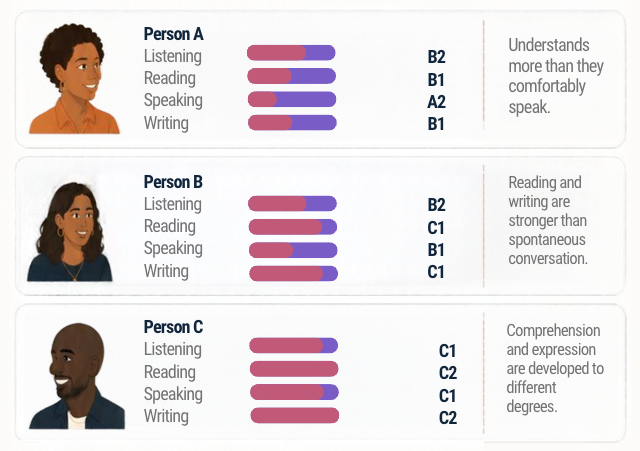
At first, it can be hard to understand the different Spanish speaking levels. But the different levels of Spanish speaking start to make more sense once we separate speaking from listening, reading, and writing. You can understand more than you can comfortably say.
To illustrate this, I want to share part of my own journey learning Spanish. I am a first-generation Mexican-American. To clarify, my parents were born and raised in Mexico, but I was born and raised in the United States. My mother spoke to me in Spanish, but my world operated in English. Naturally, English became my dominant language. Despite not speaking Spanish as much as English, I still heard Spanish every single day at home.
Throughout my life, I have had very few instances where I did not understand what someone was saying in Spanish. Aside from random cultural references, there have been very few times where I had no idea what someone was saying. My Spanish comprehension levels were always a strength, especially in the conversations I grew up around.
Consequently, this also made me think that I could speak better than I actually could. My thought process was: I can understand anything someone says in Spanish; therefore, I can also speak at a native level in Spanish. Let’s revisit the earlier graphic, this time showing the different skills separately.
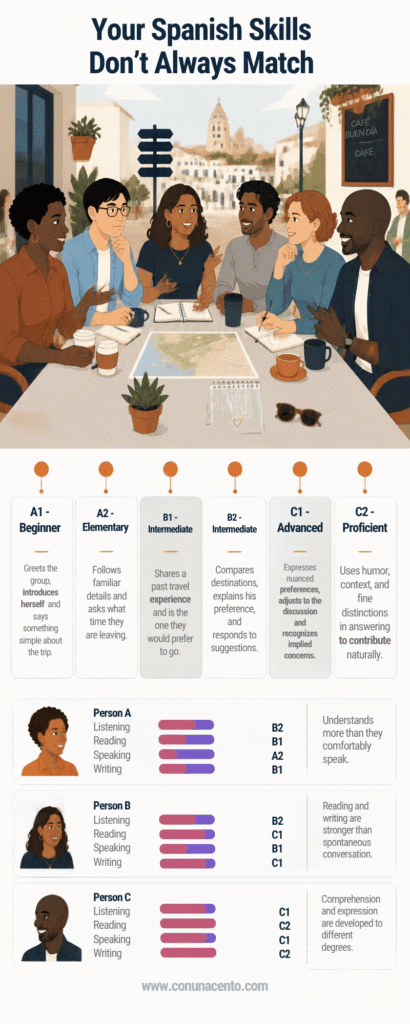
Listening and reading are receptive skills: you recognize and interpret language someone else has produced. Speaking and writing are productive skills: you have to find the words and organize the message yourself. Both involve active mental work, but they ask different things of you. Your profile also depends on what you’ve practiced. Comparing Spanish levels of fluency is more useful when you look at those skills separately.
It’s almost like watching someone ride a bike. You can watch them move the pedals and see their hands on the handlebars, but it’s a completely different experience to sit on the seat and ride it yourself. Seeing how something works doesn’t mean you can do it smoothly under pressure. In the same way, understanding a sentence doesn’t always mean you’ll be able to produce it when you need it.
Other Scales for Spanish Language Levels
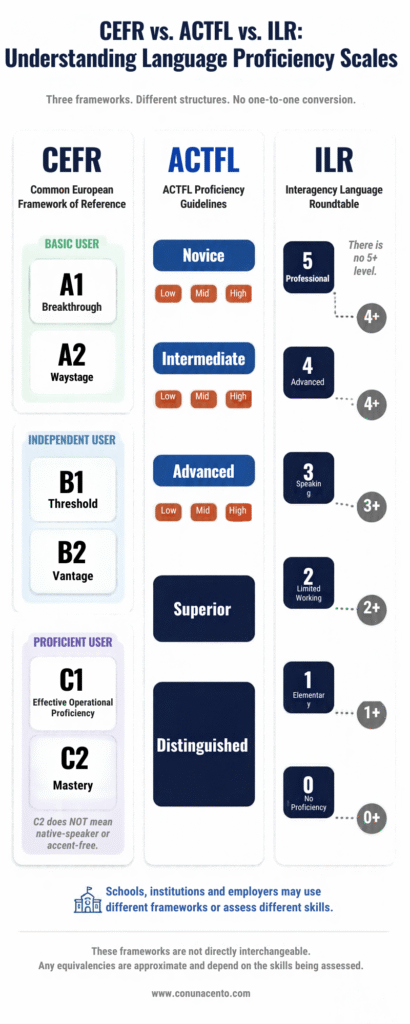
Earlier, we covered the CEFR, but there are other systems too. You might see Spanish language levels explained through a US proficiency scale, a school course, or an app’s own progress system. Those labels do not all measure the same thing.
ACTFL and ILR
Let’s start with the United States-based ones, ACTFL and ILR. ACTFL stands for the American Council on the Teaching of Foreign Languages. ILR stands for Interagency Language Roundtable. These are proficiency frameworks, not two individual tests.
The ACTFL Proficiency Guidelines use five major levels: Novice, Intermediate, Advanced, Superior, and Distinguished. Novice, Intermediate, and Advanced also have Low, Mid, and High sublevels. The ILR scale uses six base levels, from 0 to 5, with plus ratings between some of them.
As you can see, even the labels differ. Some assessments have researched links to CEFR ratings, but ACTFL explains that those links depend on the assessment and skill. That is why I would not treat a generic conversion chart as an exact translation.
High School and College Spanish
Now, let’s go on to high school and college. Here, the experience varies widely by school. In my experience, my high school had a graduation requirement where you had to take at least two years of a foreign language. We offered Spanish 1 and Spanish 2, but I don’t think either went past A2.
We also randomly had a Spanish 3 Honors course, but no regular Spanish 3. I took a placement test and placed into Spanish 3 Honors, but I could not tell you anything that I learned. I just remember sitting alongside seniors (I was a sophomore) and they were all hitting a point where “they felt like they could finally understand what people would say in grocery stores.”
On the other hand, my college experience was interesting. I took a placement exam because it could exempt me from the graduation requirement. They never actually told me what I scored. I just remember it involved writing an essay about my favorite vacation. Anyways, I placed out of the requirement. When I studied abroad in Spain, I took another placement exam, got B1.2, and then moved into B2 after an intensive course.
All of this to say, the experience varies a lot. A course called Spanish 1, 2, 3, or 4 does not automatically equal a CEFR level. AP Spanish has its own course and exam framework too. Labels such as B1.1 and B1.2 usually divide a level into smaller course stages; their exact organization depends on the provider.
Levels in Apps, Courses, and Dreaming Spanish
Moving along, apps and online courses can also give you a progress level. Before comparing it with the CEFR, check what it actually represents: completed lessons, a quiz score, hours of input, or an assessment of several skills.
Dreaming Spanish uses seven roadmap levels, alongside video labels such as Superbeginner, Beginner, Intermediate, and Advanced. Those are part of its own learning system. A number on that roadmap is not automatically a CEFR certificate.
The same applies to an online placement quiz. It can give you a starting point, but if it mainly tests grammar and reading, it cannot directly demonstrate how you handle a live conversation.
Levels for Your Resume
Phew, okay, it can be so tempting to just say you’re fluent on a resume, but I would strongly advise against that unless you can back it up in the situations the job requires. Story time: I absolutely bombed my first interview entirely in Spanish. Within the first few minutes, I realized that while my Spanish was strong, it was not strong enough for a professional setting.
The interviewer saw how defeated I was and told me, “Language is a muscle. Like a muscle, you have to practice it to get better at it.” Needless to say, I did not get that job.
For a resume, I would suggest describing both your level and what you can actually do. If you have a certificate, name the exam, level, and year. If you are estimating, label it as a self-assessment.
- Self-assessed example: “Spanish: B2; comfortable handling everyday conversations and discussing familiar work topics.”
- Certified example: “Spanish: DELE C1, awarded in [year].” Replace the year and level with your actual result.
- Task-based example: “Spanish: able to lead meetings, write reports, and work with Spanish-speaking clients.” Use only the tasks you can genuinely perform.
Word to the wise, make sure you also familiarize yourself with the workplace culture. Being able to say something grammatically does not automatically mean it is the right thing to say in an interview or meeting.
How Long Does It Take to Reach the Different Spanish Levels?
There is no fixed CEFR study-hour requirement for each level. The answer varies a lot. Your starting point, previous exposure, study routine, opportunities to use Spanish, and the skills you are practicing all affect how quickly you progress.
Course hours can give you an idea of the size of a program, but they are not the same as the total time you spend learning. For example:
- Instituto Cervantes in Vienna: its published course structure lists 60 hours for A1, 90 for A2, 120 for B1, and 180 for B2. Added together, that is 450 course hours from the start of A1 through B2.
- Instituto Cervantes in Athens: its published structure lists 60 hours each for A1 and A2, two 60-hour courses for B1, and two for B2. That adds up to 360 course hours through B2.
So those two programs illustrate a range of 360–450 course hours through B2. That is a comparison of their curricula, not a universal estimate for reaching B2. It does not capture all your homework, listening, reading, speaking practice, or previous experience, and enrolling does not guarantee that you will meet the level’s requirements.
Think back to the bike comparison: a scheduled lesson is one thing; the time you spend actually riding is another. Someone who uses Spanish every day may develop a very different skill profile from someone who only practices during class. Track what you can do more comfortably, alongside how long you’ve studied.
How to Find Your Spanish Level
A quick way to estimate your Spanish fluency level is to take an online placement test. While no test is perfect, it can help you find a starting point. Check which skills it measures before treating the result as your overall level.
- Start with a self-assessment: Compare what you can do with the CEFR self-assessment grid. Consider listening, reading, speaking, and writing separately.
- Use a placement test: Treat a quick online score as an estimate, especially if it has no speaking or writing assessment.
- Get feedback: Ask a teacher to assess a conversation and a writing sample, particularly if your skills feel uneven.
- Get certification if you need it: Check which exams the school or employer accepts. DELE offers exams from A1 to C2; SIELE Global assesses tasks from A1 to C1. They are separate assessment systems with different formats.
Spanish Levels FAQ
What do A1, A2, B1, B2, C1, and C2 mean in Spanish?
These are the six main CEFR levels of Spanish. A1 and A2 are Basic User levels, B1 and B2 are Independent User levels, and C1 and C2 are Proficient User levels. They describe increasingly demanding communication abilities, rather than six separate types of speaker.
How many Spanish levels are there?
The CEFR has six main Spanish levels: A1, A2, B1, B2, C1, and C2. A course can subdivide them into stages such as B1.1 and B1.2. Other systems have different labels and counts; for example, ACTFL has five major proficiency levels.
Is B1 or B2 Spanish higher?
B2 Spanish is higher than B1. B1 describes handling familiar situations and producing simple connected language. B2 adds more sustained, spontaneous interaction and the ability to explain viewpoints on more complex topics.
What level is conversational Spanish?
Conversational Spanish has no official CEFR cutoff. A2 can support brief, routine exchanges, B1 is a useful reference point for familiar conversations, and B2 supports more sustained interaction. The topic, speaking speed, and help available all affect how comfortable a conversation feels.
Is B2 considered fluent in Spanish?
B2 supports sustained conversation and can be a useful reference point for practical fluency. However, the CEFR does not designate B2 as a universal “fluent” threshold. A B2 speaker can still struggle with unfamiliar topics, rapid speech, or finer distinctions in meaning.
What are the levels of Spanish fluency?
People often use “Spanish fluency levels” to mean the CEFR sequence A1, A2, B1, B2, C1, and C2. More precisely, these are proficiency levels. They describe a range of skills and do not provide one universal cutoff for fluency.
What are the five levels of language proficiency?
In the ACTFL system, the five major levels are Novice, Intermediate, Advanced, Superior, and Distinguished. Novice, Intermediate, and Advanced each have Low, Mid, and High sublevels. This is a different system from the CEFR’s six main levels.
How many hours does it take to reach B2 Spanish?
There is no universal hour requirement for B2 Spanish. Two published Instituto Cervantes course structures total 360 hours in Athens and 450 hours in Vienna from A1 through B2. These are program hours, not a complete estimate of study time or a guarantee of proficiency.
Does C2 Spanish mean native-level Spanish?
C2 describes highly fluent, precise language use, including subtle distinctions in meaning. It does not mean Spanish is your native language, that you have a native accent, or that you know every regional expression. The CEFR explicitly distinguishes C2 from native-speaker competence.
Can my Spanish comprehension be stronger than my speaking?
Yes. Listening, reading, speaking, and writing can develop unevenly. You may recognize language you cannot yet produce comfortably, especially if you have had much more listening exposure than speaking practice. A useful assessment identifies those differences rather than relying only on one overall label.
If you came here looking for the different levels of Spanish fluency, use the descriptions as a starting point, then focus on the situations you actually want to handle. The goal is to communicate more comfortably, not to spend every conversation wondering which label you deserve.